We are Team ALD from the Amsterdam UMC in the Netherlands. Our mission consists of three key parts: unraveling the mysteries of X-linked adrenoleukodystrophy (ALD), developing effective treatments, and expanding newborn screening worldwide.
Our strength lies in our comprehensive, translational approach. We don’t just study ALD; we tackle it from every angle.
- Advanced diagnostics: We are developing new ways to detect and measure disease severity in ALD.
- Preclinical research: We study fat molecules (lipidomics) and cells to understand disease mechanisms.
- Clinical research: We follow patients over time to understand how the disease progresses.
- Clinical trials: We turn research discoveries into treatments that improve lives.
ALD exemplifies one of medicine’s greatest puzzles. How can identical gene mutations lead to vastly different outcomes? Although all ALD patients carry an ABCD1 mutation that causes the disease and accumulate very long-chain fatty acids (VLCFAs) in their bodies, the progression of the disease is highly unpredictable. Some patients develop adrenal insufficiency, while others face rapidly progressive and often fatal brain disease. Virtually all men and 80% of women develop progressive spinal cord disease in adulthood. However, even within families, outcomes differ dramatically. We cannot predict individual outcomes based on genetics alone.
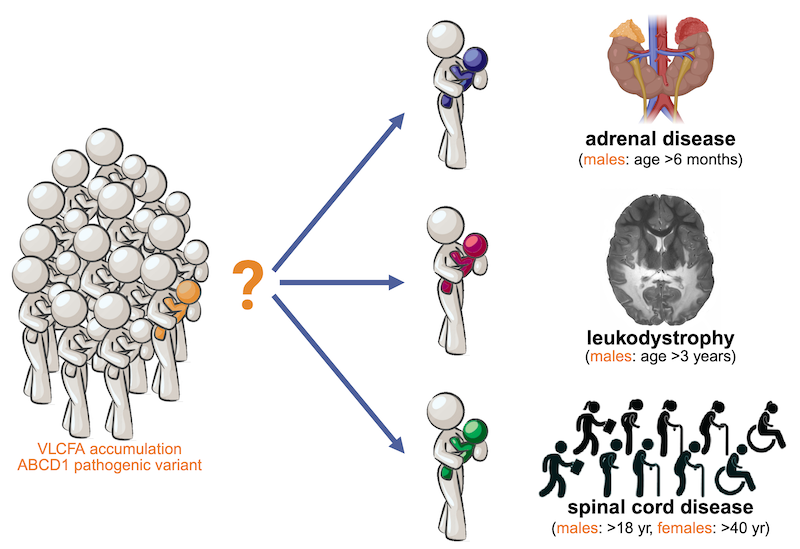
Treatment options remain limited. Although bone marrow transplantation can halt early brain disease, there is no treatment that modifies the course of spinal cord disease.
Our goal is to transform uncertainty into precision medicine by connecting molecular insights to patient outcomes. Our translational approach is bidirectional. Laboratory discoveries inform clinical care, while systematic patient follow-up, detailed clinical assessments, and biological sample banking reveal the mechanisms that drive disease. This ongoing exchange between the clinic and the laboratory enables breakthrough discoveries.